
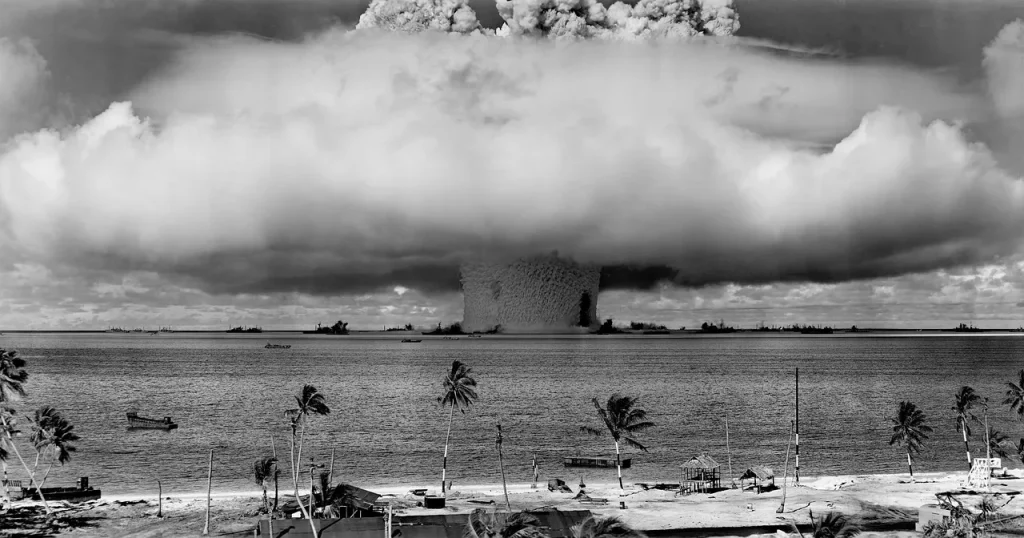
Scholar Kenneth N. Waltz, a staple in international relations academia, argues that because states coexist in anarchy, there warrants a precedent for self-help systems—in this case, nuclear weapons (Waltz, 2003). Waltz’s neorealist argument essentially embodies the idea that more nuclear weapons create a safer climate on the international scale. The main proof of his argument can be found in his translation of the Cold War. President John F. Kennedy and U.S.S.R. leader Nikita Khrushchev adopted proliferation, but each knew the high cost and minor gains of nuclear weapon usage. Waltz asks, “Why fight if you cannot win much and might lose everything?” (Waltz, 2003) The theory adopted is exact: mutually assured destruction facilitates the world to be a safer place. Regardless of state actors’ irrationality, there is a significant drawback to using nuclear weapons, and thus, they merely exist as a neorealist approach to deterrence, power, and leverage. A nuclear arsenal makes territorial gain less desirable to a state actor. Having a missile that can strike anywhere from any place is more desirable than an infantry soldier with a rifle with a max range of three hundred meters. Waltz closes his argument in this section with yet another question: “Where nuclear weapons threaten to make the cost of war immense, who will dare start them?” Waltz, 2003) State actors adopting realist ideals will always weigh the cost of adversity compared to the potential gains said action would manifest.

A well-known opponent of Waltz’s argument, Scott D. Sagan, argues that deterrence theory is heavily flawed and using examples like the Cold War is anecdotal to defend the proliferation of nuclear weapons. His basis of the argument, which heavily contrasts with Waltz’s, places nominal stock on deterrence theory and, instead, focuses on the productive adoption of organizational theory. In terms of rationality, Sagan notes that “professional military organizations possess bias and display behaviors that are likely to lead to deterrence failures or accidental wars” (Sagan, 2003). Sagan’s arguments, first appearing in ‘International Security 18’ in 1994 and later revised in 2003, detail how weaker-run states and their parochial interests will lack control when provided access to nuclear proliferation (Sagan, 1994). The Non-Nuclear Proliferation Treaty of 1968 prevented non-nuclear actors from proliferating arms, but it was not a foolproof answer, as seen with North Korea and Israel. Sagan’s use of organization theory highlights that military officers, who have access to nuclear weapons, are trained in war strategy and not diplomacy, meaning there is a higher probability for knee-jerk reactions from the system sectors.
Furthermore, there is a pragmatic argument in terms of accidental theory, and an abundance of nuclear weapons inherently causes these chances of an accident to rise linearly (Sagan, 2003). To round off his argument, Sagan points to the idea that nuclear weapons’ proliferation creates a vacuum for preventive attack, and weaker states may be viewed as hostile for merely wanting to adopt deterrence measures (Sagan, 2003). We can note this with actors like North Korea and Iran, the latter not even possessing a nuclear weapon at the time of this writing. Sagan closes with the point that the lack of a hot war during the Cold War “should not be an excuse for inaction with either arms control or non-proliferation policies” (Sagan, 2003).
Both arguments present a pragmatic debate on the proliferation of an actor’s nuclear arsenal. One is based on history; the other is based on theory and contemporary observation. This summary does not rule one another out, as both possess relatively strong arguments. Man’s inherently evil or good nature must be considered, and how those idiosyncrasies play into the responsibility of possessing nuclear weapons. The oversaturated idiom, “If you give the man a stick, the first thing he wants to do is hit someone with it,” is certainly not a valid excuse for world powers to forfeit diplomacy and rational behavior.
Bibliography
Sagan, Scott D. “The Perils of Proliferation: Organization Theory, Deterrence Theory, and the Spread of Nuclear Weapons.” International Security 18, no. 4 (1994): 66-107. Accessed October 5, 2020. doi:10.2307/2539178.
Sagan, Scott Douglas., and Kenneth Neal Waltz. “Chapter 1: More May Be Better.” In The Spread of Nuclear Weapons: an Enduring Debate: with New Chapters on Iran, Iraq, and North Korea, and on the Prospects for Global Nuclear Disarmament, 3–45. New York, NY: Norton, 2013.
Sagan, Scott Douglas., and Kenneth Neal Waltz. “Chapter 2: More Will Be Worse.” In The Spread of Nuclear Weapons: an Enduring Debate: with New Chapters on Iran, Iraq, and North Korea, and on the Prospects for Global Nuclear Disarmament, 46-87. New York, NY: Norton, 2013.