
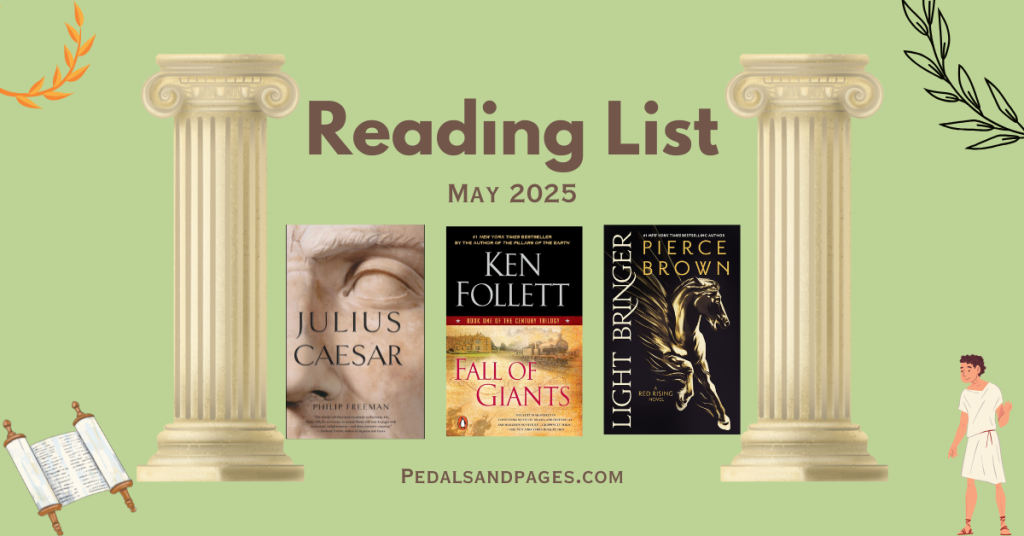

Welcome, dear readers, to May! With the school semester wrapping up and wedding planning, I had less reading time this month than I’d hoped for. Nonetheless, here are the titles I read and my thoughts on each. Enjoy!
Julius Caesar by Philip Freeman
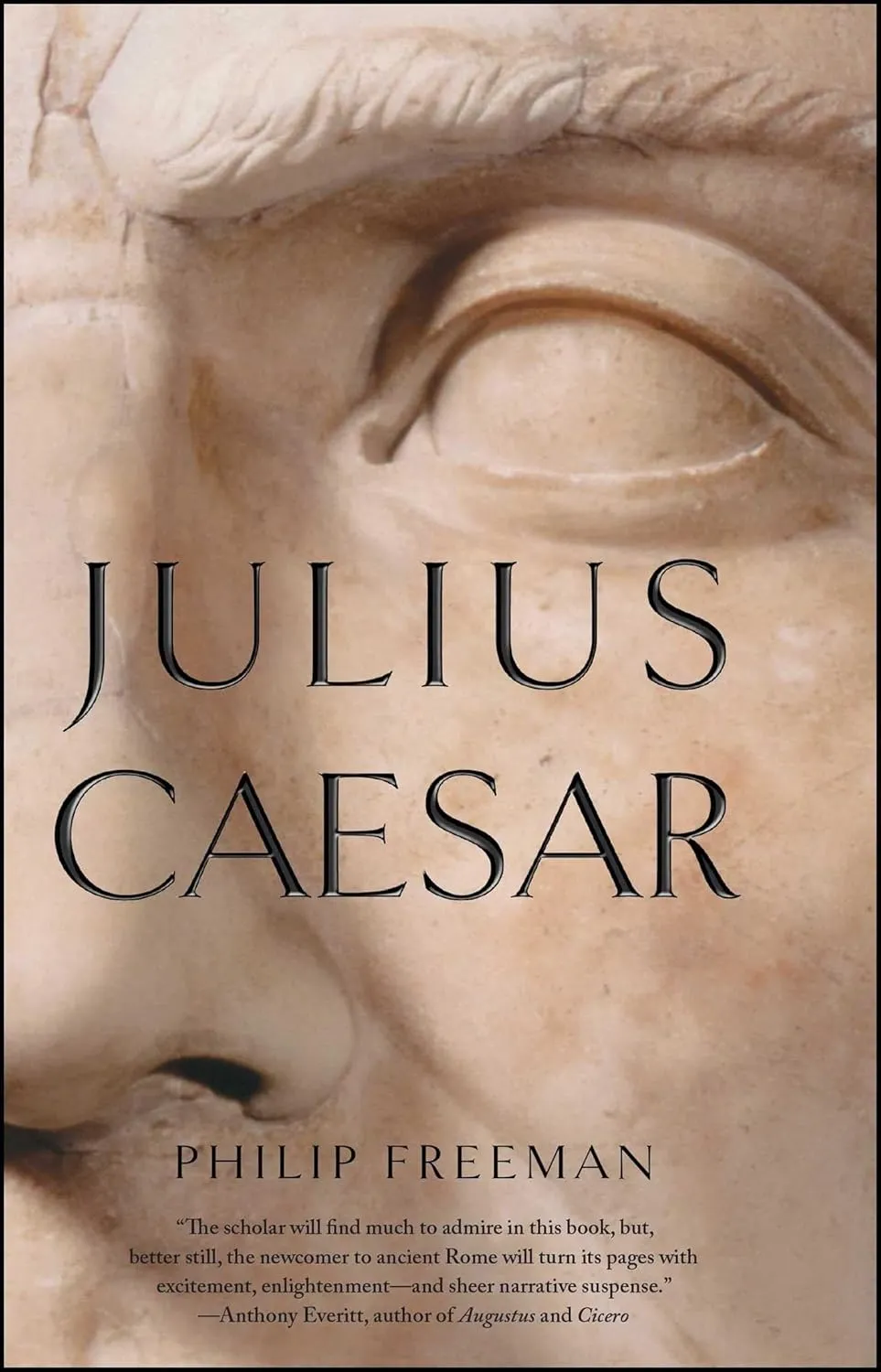
Philip Freeman is one of my favorite authors. His book on Alexander the Great was a masterpiece, and I was delighted when I saw that he wrote a book on Julius Caesar. Freeman observes the intricacies of how Caesar ushered in the final days of the Roman Republic. Freeman details the career of Caesar and the highlights of his campaigns in Gaul and even two expeditions to Britain. Although I have read quite a bit on the Roman Republic, I learned new things in this text, such as the myth that the C-section was named because Caesar was born via the cesarean section. However, most evidence points away from this insofar as his mother lived after the birth. Early on, Freeman conveyed that many famous figures throughout history lacked detailed accounts of their childhoods – a natural consequence of the fact that their fame was unexpected and therefore rarely documented. This was the case of Caesar, and, sadly, we don’t know a whole lot about his early years.
Like his book about Alexander, Freeman has a brilliant way of translating dry and exhaustive sources into fluent and engaging historical material, even for those who may be new to Caesar of the Republic in general. History remembers Caesar in a myriad of ways: a tyrant, or a man simply trying to bring order to the chaos of the dying days of the Republic. Regardless of the doctrine you believe in, Freeman will provide an unbiased account of one of history’s most perplexing figures. 4/5 stars for me! ⭐⭐⭐⭐
Fall of Giants by Ken Follett
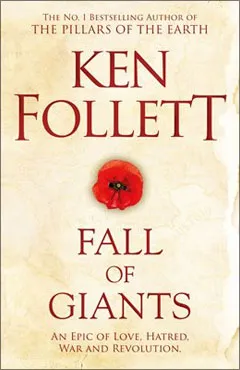
In March, I reviewed Follett’s Pillars of the Earth—a masterpiece of historical fiction that ended up on Oprah’s reading list (yes, that Oprah!). Follett hits it out of the park again with this epic novel following several characters through the lead-up and events of World War I. The book has a similar gravitas to Pillars of the Earth—at least in my opinion. It is packed with action, drama, romance, heartbreak, and tragedy.
Follett is a master builder in literature and has a serious knack for developing his many characters. It can be challenging to follow along with the plots, especially with so many characters, particularly when they are added throughout the book at random. I never once felt lost in the story, and I think this is what sets Follett apart from many authors. He can shape the plot and characters, adding deep elements, without the reader feeling lost. Fall of Giants is part of the Century Trilogy. I have yet to read the next two books, but keep an eye on my reading list for when those reviews come out.
As a history buff, I enjoyed how Follett pushes the edge of the envelope by mixing real characters from history (like Winston Churchill) with fictional characters. It’s an interesting dynamic, and one that I feel doesn’t always work out; however, just like with his plot mechanics, Follett pragmatically mixes fiction and real history. In the opening pages of the book, the author explains why he chose to go this route, and also understands that some readers might be thrown off by this style of writing. Indeed, it took me a few chapters to get used to seeing the name Winston Churchill mixed in with the fictional parts. As I said earlier, this didn’t take away from the experience for me, and I felt even more involved in the plot and with the characters. 4/5 stars for me! ⭐⭐⭐⭐
How Rome Fell by Adrian Goldsworthy
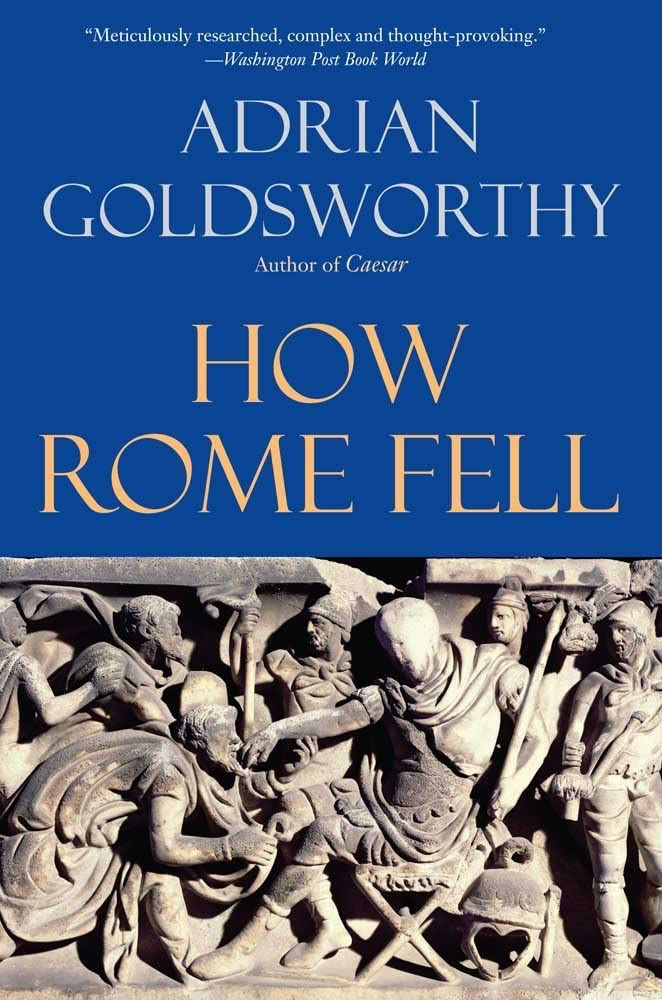
Tackling the decline and fall of one of the world’s greatest empires is no easy feat. Indeed, Edward Gibbon attempted to do such a thing in a 6-volume series titled The Decline and Fall of the Roman Empire, published in the 18th century. I must admit, I have all six volumes but have not read them. Gibbon’s work, at the time, was highly renowned, and it continues to hold a special place in the library of many, myself included. However, like many historical texts, they become outdated as new facts, discoveries, and archaeological evidence come to light. Okay, so why am I talking about Gibbon’s book? I am doing this because I want to highlight how difficult a subject this is to cover. Goldsworthy is taking on a brute of a task, and kudos to him on the performance.
Goldsworthy styles his book in chronological order and describes the idiosyncrasies of each of Rome’s notable leaders. Through this, I was able to read and break down each century leading up to the fall in great detail. Goldsworthy even navigates the excruciatingly complex history of the Eastern and Western empires (the former of which lasted for another thousand years until the fall of Constantinople). Goldsworthy provides depth where it is needed and doesn’t weigh down his text to read like a primary source. Of course, we have to take the author’s translation of events with the primary texts in mind. As someone who cannot devote months to scrolling through primary sources (albeit that sounds kind of fun), I appreciate the work and dedication that some of these authors go into.
Like many historians before him, Goldsworthy does not offer a definitive explanation for the fall of the Roman Empire. While numerous theories exist—Gibbon famously blamed the rise of Christianity—Goldsworthy avoids taking a firm stance, choosing instead to explore the complexity of the issue.
Some selected notes from my reading (click to view)
Roman rule in Britain ended somewhat abruptly. AD 410 is the general date for when this happened.
During the fall of the Roman Empire, technology seemed to have degraded for for instance, Thatch roofs replaced typical roof tiles, and skilled labor seemed to dwindle. I wonder why this is.
Towards the fall of the empire, usurpers did not have to be prominent people like in the past. They just needed enough influence and military backing to take over.
The rule of three emperors at once seemed to work ok. But not enough.
The USA may think of the Roman Empire as the greatest of all time. But countries like China have seen greater empires and may not view the Roman Empire as much.
The epilogue had talks of nuclear weapons and presidential succession.
I give Goldsworthy’s book 4/5 stars! ⭐⭐⭐⭐
The Dog Stars by Peter Heller
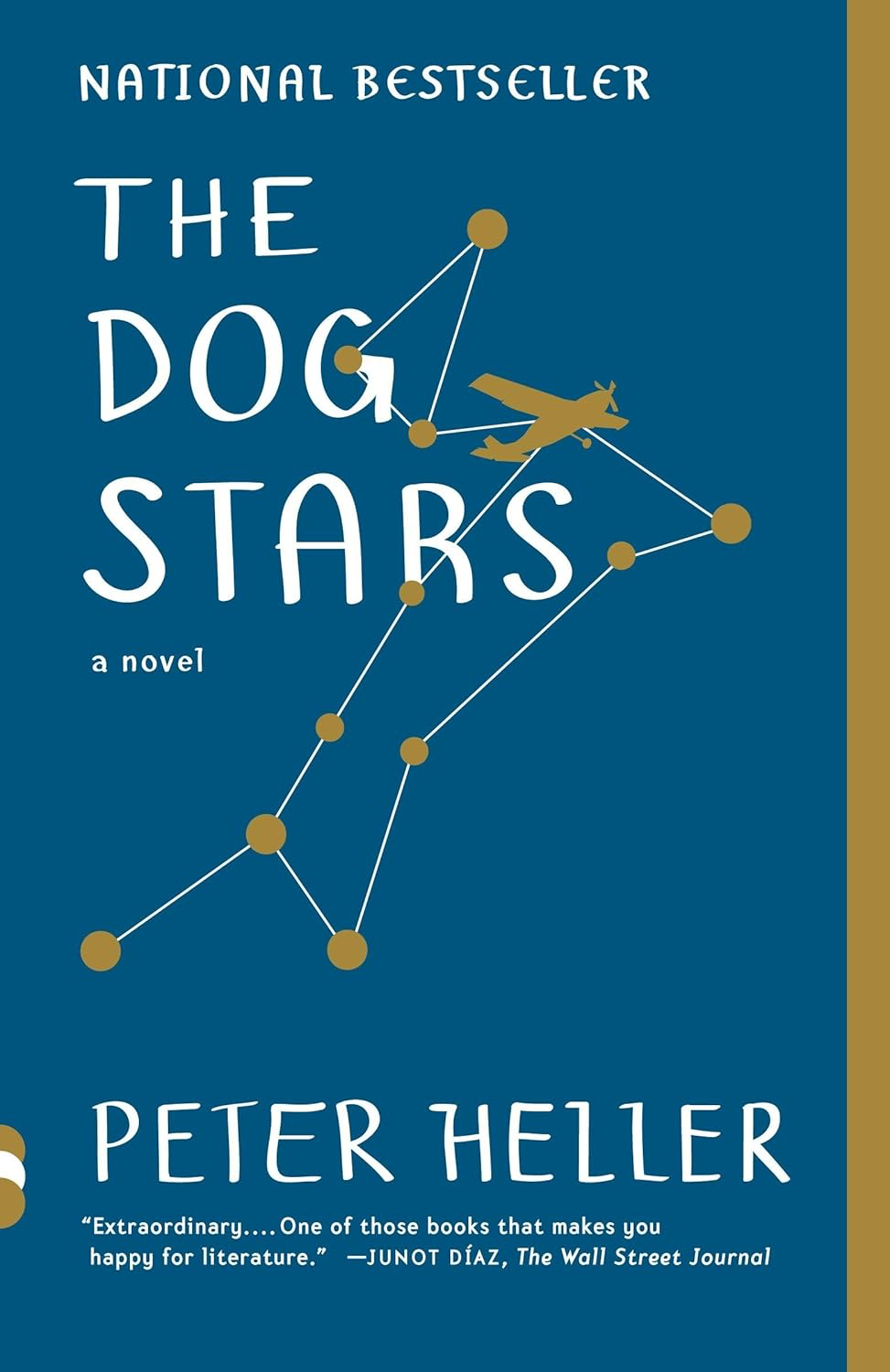
I was driving down the road a few weeks ago and saw an abandoned silo in a field about a mile off the highway. It made me wonder how well it would work as a doomsday hideout. This prompted me to visit Reddit and seek out a world-building post-apocalyptic book. The community did not disappoint, and, within a day, I found a copy of The Dog Stars in my hands.
The plot surrounds two men and a dog who have decided to make a small airfield their base of operations. There is enough detail in the book regarding how the base was built and maintained. The more books I read, the more I appreciate authors who take the time to build rich, immersive worlds. Sci-fi books are really good about this.
The Dog Stars reminds me of a classic novel. It is both lightweight and alluring. The writing style is well done, and the book is a quick read. And, hey, who doesn’t like a cool dog as an important character in the plot? I will give this novel 4/5 stars, as I was hoping for just a bit more story development. That is just my opinion, though, and I highly recommend checking this one out. ⭐⭐⭐⭐
Light Bringer by Pierce Brown
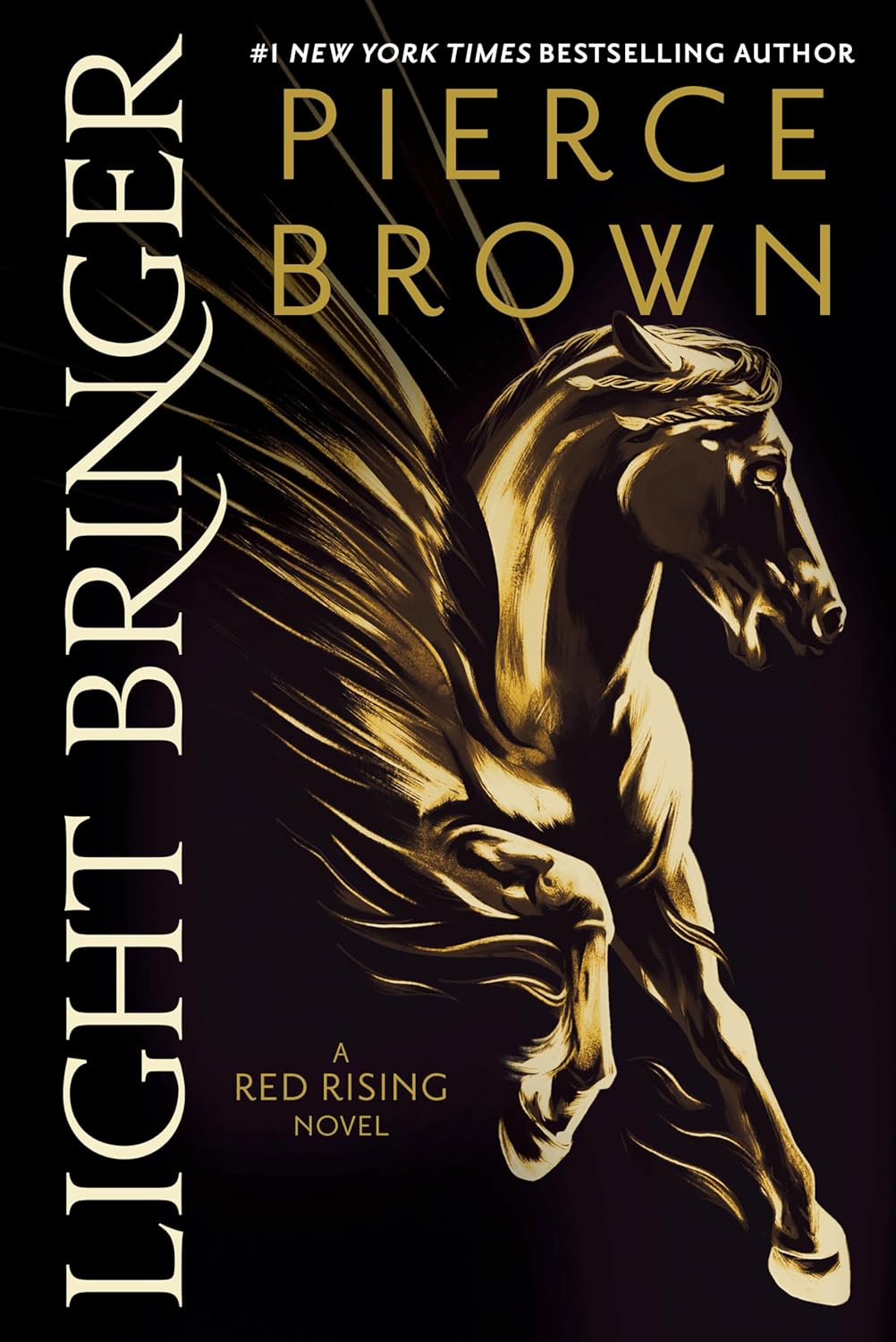
Well, folks… I’m officially caught up with the Red Rising series. Like millions of other readers, I now find myself among the ranks eagerly awaiting Pierce Brown’s next installment. Woohoo! Last month, I finished Dark Age—and as I’ve hinted before, that book was absolutely brutal, overflowing with tragedy. Light Bringer offers a counterbalance to that darkness. While still packed with the good, the bad, and the downright ugly, it brings a measure of hope and resolution.
If you haven’t delved into the Red Rising saga, what are you waiting for?! In all seriousness, this series is fantastic—even if you’re not usually into sci-fi. It features phenomenal battle scenes, immersive world-building, rich character development, comedy, tragedy, and just about everything in between. And if you’re a fan of space, you’ll feel right at home.
It’s been a genuine joy to read every book in this series so far. You can see Brown’s evolution as a storyteller with each new installment. His humility and distinctive voice, in my opinion, are a big part of what keeps readers so deeply engaged. I’m very curious to see how he wraps up the saga in the next—and final—book of the series, Red God. From what I’ve gathered, it’s set to come out sometime next summer. 5/5 stars for me! ⭐⭐⭐⭐⭐
Thanks for checking out my reading list! I will see you all back here next month.