
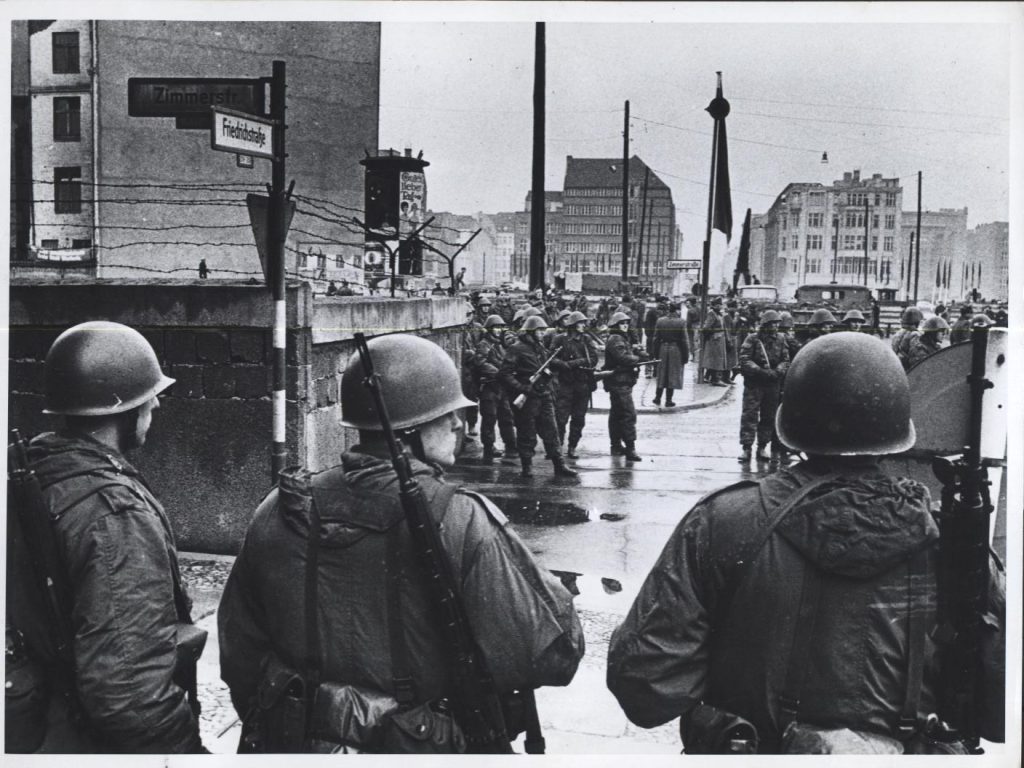
Dating back to homo-sapiens fundamental conflicts, man has undoubtedly embraced a neo-warrior complex in almost any facet of historical study. The underlying circumstance of man’s desire for destruction is often described with the simple theory that “if you give the man a stick, the first thing he wants to do is hit someone with it.” Embracing this culture, the state proliferation of nuclear arsenals has created a hot debate on the good and bad side of nuclear armament dating back to the Manhattan Project. Scholars of international relations theory argue that mutually assured destruction creates a suitable approach to deterrence. Opponents of this theory contend that increasing nuclear weapons proliferation only creates numerous misapprehensions in numerous state actors. The world spent the latter part of the 1900s nail-biting as it watched two powers, the United States and the Soviet Union, build arsenals and barely construct excuses not to use them on one another.
A New Step Backwards
America’s inward turn will surely vitiate all progress of post-Cold War diplomacy. While it is true that the United States has, historically, adopted a prolix doctrine to international diplomacy, we as a society cannot simply replace it with a doctrine of cynicism. Diplomacy abroad has certainly had its moments, the Iraq War being one of them. Below, I have outlined some key affairs that could become disrupted if the United States adopts a stark policy of isolationism.
- A vacuum of Power: The absence of American leadership can create a power vacuum, potentially allowing other, less stable or authoritarian powers (e.g., China or Russia) to expand their influence, sometimes at the cost of democratic values and international law.
- Reduced Conflict Mediation: The U.S. has often acted as a mediator in conflicts (e.g., Israel-Palestine, NATO operations). Without its involvement, conflicts may escalate unchecked.
- Disruption of Trade Networks: The U.S. is a cornerstone of global trade systems like the WTO. Isolationism could destabilize trade routes, disrupt supply chains, and lead to protectionism worldwide.
- Financial Uncertainty: The U.S. dollar serves as the global reserve currency. A retreat from international involvement might weaken trust in the dollar, destabilizing global markets.
- Weakening NATO and Other Alliances: Many countries rely on American commitments for their security (e.g., NATO in Europe, alliances in East Asia). If America withdraws, allies may feel abandoned, which could lead to regional arms races or the formation of new, competing alliances.
- Undermining Global Cooperation: U.S. leadership in addressing issues like climate change, pandemics, and terrorism is vital. Isolationism undermines collective problem-solving efforts.
- Absence of a Democratic Counterbalance: Historically, the U.S. has promoted democratic ideals and human rights. Isolationism could embolden authoritarian regimes to act more aggressively, suppress dissent, and destabilize regions.
- Reduced Aid and Relief Efforts: The U.S. is one of the largest contributors to international aid. Isolationism could lead to reduced funding for global health initiatives, disaster relief, and development programs, exacerbating poverty and suffering.
- Refugee Crises: Without U.S. intervention in conflicts or humanitarian support, refugee crises could worsen, destabilizing neighboring regions.
- Cultural and Ideological Influence: The U.S. wields significant soft power through its culture, technology, and values. Isolationism diminishes this influence, potentially allowing other ideologies to dominate.
America’s turn to isolationism weakens the interconnected systems that sustain global peace, prosperity, and development. It risks destabilizing alliances, empowering adversarial nations, and exacerbating global challenges that require multilateral solutions.
Scholar Kenneth N. Waltz, a staple in International Relations academia, argues that because states coexist in anarchy, there warrants a precedent for self-help systems- in this case, nuclear weapons (Waltz, 2003). Waltz’s neorealist argument essentially embodies the idea that more nuclear weapons create a safer climate on the international scale. The main proof of his argument can be found in his translation of the Cold War. President John F. Kennedy and U.S.S.R leader Nikita Khrushchev adopted proliferation, but each knew the high cost and minor gains of nuclear weapon usage. Waltz asks the question “Why fight if you cannot win much and might lose everything?” (Waltz, 2003) The theory adopted is exact- mutually assured destruction facilitates the world to be a safer place. Regardless of state actors’ irrationality, there is a significant drawback to using nuclear weapons, and thus, they merely exist as a neorealist approach to deterrence, power, and leverage. A nuclear arsenal makes territorial gain less desirable to a state actor because having a missile that can strike anywhere from any place is more desirable than an infantry soldier with a rifle with a maximum range of three hundred meters. Waltz closes his argument in this section with yet another question: “Where nuclear weapons threaten to make the cost of war immense, who will dare start them?” (Waltz, 2003) State actors adopting realist ideals will always weigh the cost of adversity compared to the potential gains said action would manifest. A well-known opponent of Waltz’s argument, Scott D. Sagan, argues that deterrence theory is heavily flawed and that using examples like the Cold War is anecdotal to defend the proliferation of nuclear weapons. His basis of the argument, which heavily contrasts with Waltz’s, places nominal stock on deterrence theory and, instead, focuses on the productive adoption of organizational theory. In terms of rationality, Sagan notes that “professional military organizations possess bias and display behaviors that are likely to lead to deterrence failures or accidental wars” (Sagan, 2003). Sagan’s arguments, first appearing in ‘International Security 18’ in 1994 and later revised in 2003, detail how weaker-ran states, and their parochial interests, will lack control when given access to nuclear proliferation (Sagan, 1994). The Non-nuclear Proliferation Treaty of 1968 prevented non-nuclear actors from proliferating arms, but it was not a foolproof answer, as seen with North Korea and Israel. Sagan’s use of organization theory highlights that military officers, who have access to nuclear weapons, are trained in war strategy and not diplomacy, meaning there is a higher probability for knee-jerk reactions from the system sectors. Furthermore, there is a pragmatic argument in terms of accidental theory, and an abundance of nuclear weapons inherently causes these chances of an accident to rise linearly (Sagan, 2003). To round off his argument, Sagan points to the idea that nuclear weapons proliferation creates a vacuum for preventive attack, and weaker states may be viewed as hostile for merely wanting to adopt deterrence measures (Sagan, 2003). We can note this with actors like North Korea and Iran, the latter not even possessing a nuclear weapon at the time of this writing. Sagan closes with the point that the lack of a hot war during the Cold War “should not be an excuse for inaction with either arms control or non-proliferation policies” (Sagan, 2003). Both arguments present a pragmatic debate on the proliferation of an actor’s nuclear arsenal. One is based on history; the other is based on theory and contemporary observation. This summary does not rule one another out, as both possess relatively strong arguments. Man’s inherently evil or good nature must be considered as how those idiosyncrasies play into the responsibility of possessing nuclear weapons. The overused idiom of “if you give the man a stick, the first thing he wants to do is hit someone with it” is certainly not a valid excuse for world powers to lack diplomacy and rational behavior.
This paper was originally written for a political science class I took at the University of Alaska Fairbanks (around 2019).